
Calendar
Related Videos
The Calendar presents a historical view of a specific calculation. Each day in the configured time period is displayed as a tile. The color of the tile indicates to which range value of the day falls under. Multiple months can be displayed by a single calendar segment.
Calculation
For more general calculation options, see Editing Scalar Valued Calculations chapter.
The calculation options control, how the displayed values are calculated. Only calculation functions that produce numeric results can be selected in calendar.Period Settings
This group defines period over which we want to display values.Period
A desired type of time period to be displayed in calendar.Month - A month like calendar view will be displayed.
Week - A week like calendar view will be displayed.
Number of Displayed Periods
Required
The number of months/weeks to display.Displayed Period/Last Displayed Period
Required
When only one period should be displayed this option defines which period it will be.
When multiple periods should be displayed this option defines which will be the last displayed period.This Period - The calendar displays the currently ongoing Month or Week.
Last Period - The calendar displays the previous Month or Week.
Other Period - If this option is chosen, how far into the past the Displayed Period/Last Displayed Period is has to be provided.
Last Displayed Period - # Periods Ago
Available only when “Other Period” is selected as Displayed Period/Last Displayed Period
When multiple periods should be displayed this option defines which will be the last displayed period.Value of the Day
Required
Defines, what result should be used in the Calendar.First - The first recorded result of each day is displayed.
Last - The last recorded result of each day is displayed.
Min - The minimal recorded result of each day is displayed.
Max - The greatest recorded result of each day is displayed.
Delta - The difference between the Last result of the day and the one before is displayed.
Show Current Day
Available only when “This Period” is selected as Displayed Period
Whether the value for current day should be displayed. Value is being automatically updated if displayed.Weekdays
The Calendar can be configured to display only certain relevant days of the week.First Day Of Week
Inheritable
Specifies, which day should be displayed and considered as first of each week.Monday
Tuesday
Wednesday
Thursday
Friday
Saturday
Sunday
Monday, …, Sunday
Inheritable
Visibility of each day can be configured with its corresponding dropdown. Non-Working days are hidden.Working Day - The day is displayed and considered as a working day.
Non-Working Day - The day is hidden and considered as a non-working day.
Appearance
The style of a CalendarBackground Color
For more information see Color Field section.
Color of the background.Headers
Visual configuration of calendar headers.Day Headers
Inheritable
Controls, whether the day of the week should be displayed above all calendar day columns.Show - The day of the week is displayed.
Hide - The day of the week is not displayed.
Period Headers
Inheritable
Controls, whether the displayed time period should be described in header.Show - The time period is displayed.
Hide - The time period is not displayed.
Height
Inheritable
Height of the headers, that is measured in permilles of the entire Layout’s height.Text Color
Inheritable
For more information see Color Field section.
Color of the text.Background Color
Inheritable
For more information see Color Field section.
Color of the background.Text Style
Inheritable
For more information see Text Style section.
Type of font to use and whether bold or italic text should be used.Font Size Coefficient
Inheritable
The font size is calculated by multiplying available height for the text by font size coefficient.
Day Numbers
Visual configuration of day numbers.Visibility
Inheritable
Whether day numbers should be visible.Show - Day numbers are displayed.
Hide - Day numbers are not displayed.
Content
Inheritable
Content of the day numbers.Title - Only the title of the day is displayed.
Paging Info - Only the paging info of the day is displayed.
Title and Paging Info - Both the title and the paging info of the day are displayed.
Position
Position of the day numbers. If Float on Top or Float on Bottom is selected, day numbers float over the segment which may cause overlapping.Float on Top - Day numbers float over the segment.
Float on Bottom - Day numbers float under the segment.
Top - Day numbers are displayed on the top of the segment.
Bottom - Day numbers are displayed on the bottom of the segment.
Height
Inheritable
Height of day numbers.Text Color
Inheritable
For more information see Color Field section.
The color of the day number, displayed in the tile.Background Color
Inheritable
For more information see Color Field section.
Color of the day numbers background.Text Style
Inheritable
For more information see Text Style section.
Type of font to use and whether bold or italic text should be used.Font Size Coefficient
Inheritable
The font size is calculated by multiplying available height for the text by font size coefficient.Horizontal Alignment
Inheritable
Position of day numbers on horizontal axis.Left - Day numbers are aligned to the left.
Center - Day numbers are aligned to the center.
Right - Day numbers are aligned to the right.
Padding
Inheritable
Available only when the horizontal alignment is “Left” or “Right”
The size of a padding between the day numbers and day numbers’s border in “em” units. 1 em equals to the font size of the associated text.
The padding is applied to the side where the text is horizontally aligned.
Values
Visual configuration of calendar’s day tiles.Presentation Type
Required
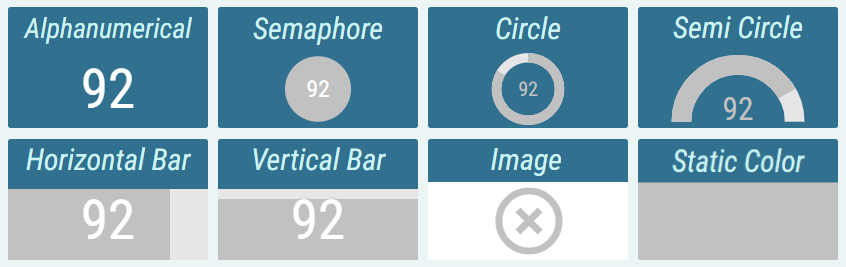
Defines how value should be presented.Alphanumeric - The value is presented as a pure text, without any additional graphical elements.
Semaphore - The value is enveloped in a colored circle. The circle changes color based on configured conditional styles. The semaphore is used, when the state is more important than the value itself.
Circle - The value is accompanied by a circle indicator. The indicator represents the level of fulfillment of a configured goal.
Semi Circle - The value is accompanied by a semi-circle indicator. The indicator represents the level of fulfillment of a configured goal.
Horizontal/Vertical Bar - The value is accompanied by a rectangular indicator. The indicator represents the level of fulfillment of a configured goal.
Image - An image is applied.
Static Color - A static color is applied.
Display Format
Required
Format in which value should be displayed. When Raw is selected, the value is displayed without any transformation.Custom Display Format
Available only when “Custom” is selected as a Display Format
For more information see Custom Display Format section.
Custom format in which value should be displayed.Text Color
Inheritable
For more information see Color Field section.
Color of the text.Semaphore/Circle/Semi Circle/Bar Color
Inheritable
According to the selected presentation type
For more information see Color Field section.
Color of the Semaphore/Circle/Semi Circle/Bar.Empty Bar Color
Inheritable
Available only when “Horizontal/Vertical Bar” is selected as a presentation type
For more information see Color Field section.
Background color of the bar itself.Background Color
Inheritable
Not available, if the “Image” presentation type is selected
For more information see Color Field section.
Color of the background.Text Style
Inheritable
Not available, if the “Image” presentation type is selected
For more information see Text Style section.
Type of font to use and whether bold or italic text should be used.Text Sizing
Inheritable
Not available, if the “Image” or “Static color” presentation type is selected
Controls, how font size is calculated.Regular - Font is sized relatively to calendar’s cell height. In case of Circle, Semi Circle and Semaphore presentation type, font is sized relatively to Circle’s/Semi Circle’s/Semaphore’s height.
Best Fit - Font is dynamically sized to always fit inside calendar’s cell.
Font Size Coefficient
Inheritable
Available only when “Regular” is selected as a text sizing
Not available if “Image” or “Solid Color” is selected as a presentation type
The font size is calculated by multiplying available height for the text by font size coefficient. In the case of semicircle, circle and semaphore presentation type combined with the regular sizing, available height is defined by the height of the circle/semicircle/semaphore. Otherwise, by the height of the container.Text Wrapping
Whether the text should be split into multiple lines if the text is wider than the whole segment.Preserve Whitespace
Whether whitespaces should be preserved as they are, or be replaced with a single space character.Enable Hyperlink
Whether the value should be clickable and trigger configured action.Text
Not available if “Image” presentation type is selected
Defines a text that will be displayed as a hyperlink instead of current value. {{value}} placeholder can be used to insert current value anywhere in the text. This placeholder is replaced with value that is formatted using configured display format at runtime. This setting allows users to customize the text for a more descriptive or interactive experience.Uri
Defines a Uniform Resource Identifier (URI) that determines the action triggered upon clicking. {{value}} placeholder can be used to insert current value anywhere in the text. This placeholder is replaced with value that is not formatted at runtime. Users can specify:Webpage URLs (e.g., “https://example.com”) to open specific websites.
Email addresses (e.g., “mailto:example@mail.com”) to compose an email using the default mail client.
Phone numbers (e.g., “tel:0123456”) to initiate a phone call on compatible devices.
Custom URIs (e.g., “im:John Smith”) for instant messaging, which opens the default messaging app to send a message.
Target
Defines the target window or tab where the URI action will be executed:New Tab: Opens the specified URI in a new browser tab.
Current Tab: Loads the URI in the current browser tab, replacing the current content.
Pop-up: Displays the URI content in a new pop-up window.
None: Disables any specific target behavior, allowing the browser’s default action.
Choose Display Range Min Manually
Available only when “Circle”, “Semi Circle” or “Bar” presentation type is selected.
Whether the minimum on the value range is defined manually.Min
Value, that defines the minimum on the value range.
Choose Display Range Max Manually
Available only when “Circle”, “Semi Circle” or “Bar” presentation type is selected.
Whether the maximum on the value range is defined manually.Max
Value, that defines the maximum on the value range.
Horizontal Alignment
Available only when “Regular” text sizing and “Alphanumeric” presentation type are selected Controls, where the value should be aligned on the horizontal axis.Left - The value is aligned to the left.
Center - The value is aligned to the center.
Right - The value is aligned to the right.
File
Available only when “Image” presentation type is selected
For more information see Static content chapter.
Relative path of the image, that should be displayed. Using the {{value}} placeholder in the path, an image can dynamically change, based on the value.Image Horizontal Alignment
Available only when “Image” presentation type is selected
Controls, where the image should be aligned on the horizontal axis.Left - The image is aligned to the left.
Center - The image is aligned to the center.
Right - The image is aligned to the right.
Image Vertical Alignment
Available only when “Image” presentation type is selected
Controls, where the image should be aligned on the vertical axis.Top - The image is aligned to the top.
Middle - The image is aligned to the middle.
Bottom - The image is aligned to the bottom.
Image Size
Available only when “Image” presentation type is selected
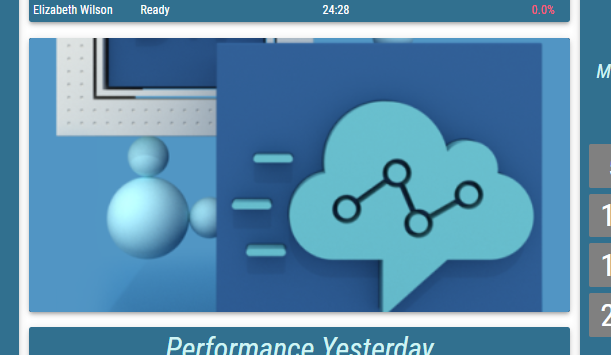
Decides, how the image is adjusted to the Segment’s size.Cover - The image is resized to cover the whole Segment, without deforming the image. No uncovered spaces are present. However one of image’s axis may overlap outside of the Segment’s boundaries.
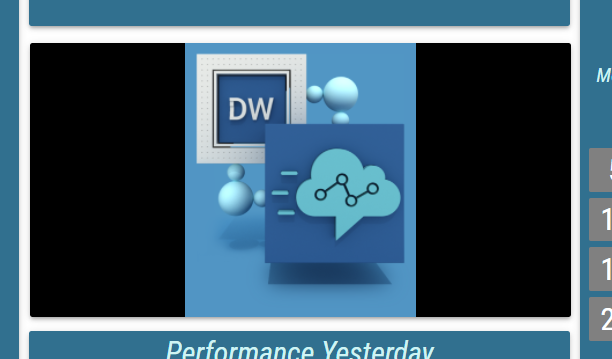
Contain - The image The image is resized to be fully displayed, in largest possible size, without deforming the image. Uncovered spaces, filled with the Background Color, are present.
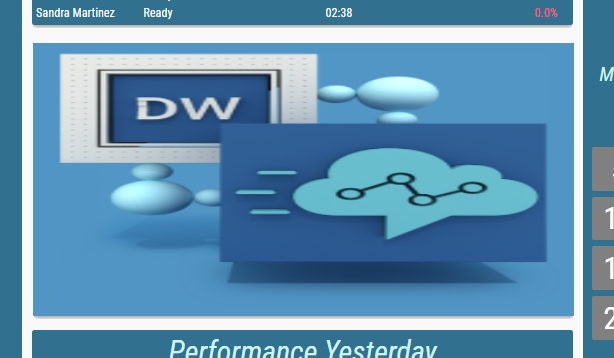
Fill - The image fully fills the entire Segment’s size. The image may be deformed. No uncovered spaces or overlapping occurs.
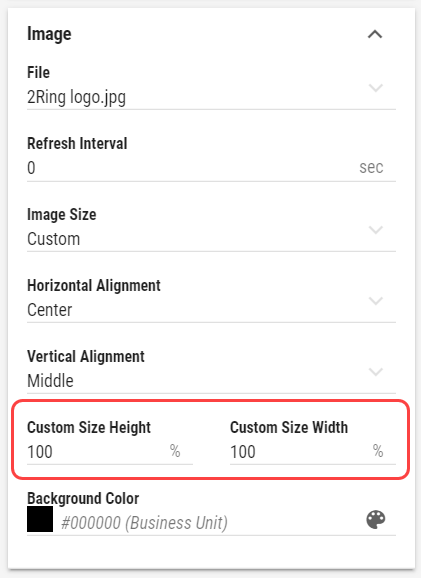
Custom - When selected, Custom Size Height and Custom Size Width fields are displayed. These fields define size of the image in percentages of the Segment’s size.
Effects and Filters
Available only when “Image” presentation type is selected
Controls, adjusting the image, such as Brightness, Contrast, Opacity etc. Click to revert image to its default values.Custom Null Value
Inheritable
A custom value that is displayed when the value is null.Corner Radius
Inheritable
Corner radius of the values can be adjusted with a slider or a text field for a custom value. Measured in permilles of the entire Layout’s height.
Conditional Styles For more information see Conditional Styles chapter.
Conditional Styles are used to modify appearance of the value based on its data.